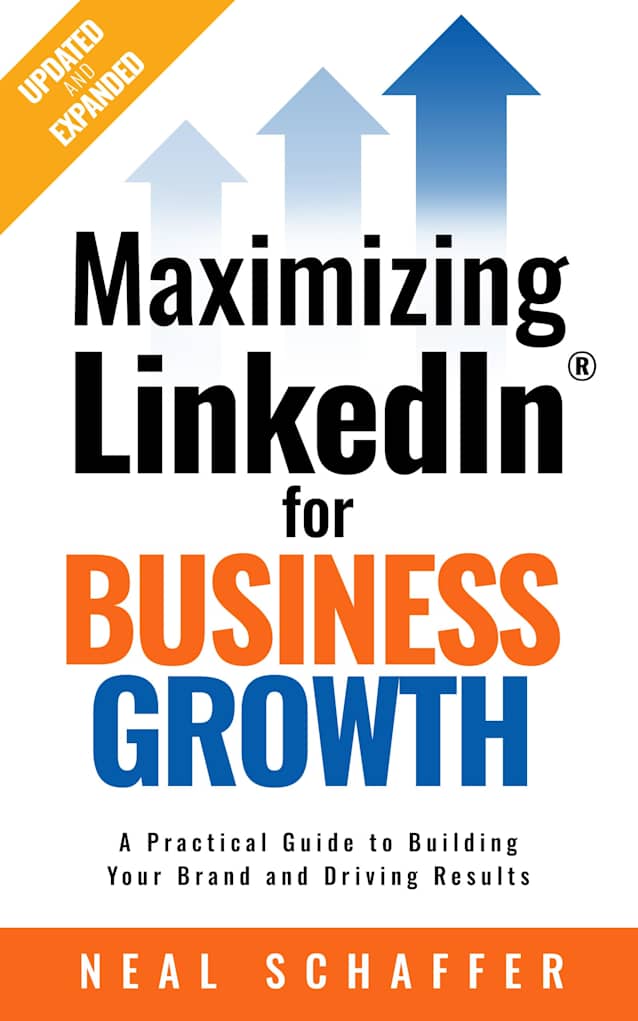
Maximizing LinkedIn for Business Growth, Updated & Expanded (2nd Edition)
About
Maximizing LinkedIn for Business Growth: A Practical Guide to Building Your Brand and Driving Results
By Neal Schaffer | 2nd Edition | Published January 1, 2026
Download a free preview version of Maximizing LinkedIn for Business Growth here
About the Book
Maximizing LinkedIn for Business Growth is a practical, comprehensive guide that transforms LinkedIn from a passive digital resume into an active relationship-building engine that consistently generates business opportunities. Written by Neal Schaffer — a fractional CMO, global speaker, university educator, and digital marketing strategist who has been in the industry since 2008 — this book provides a complete, step-by-step system for professionals, entrepreneurs, and business leaders who want to leverage LinkedIn strategically for lead generation, brand building, and professional growth.
Unlike other LinkedIn books that focus narrowly on job searching or surface-level tips, this book treats LinkedIn as a full-spectrum business development platform. Across 13 chapters and approximately 30,000 words, Neal draws on his experience teaching at UCLA Extension and Rutgers Business School, consulting with companies worldwide, and building his own brand on LinkedIn to deliver actionable strategies that work regardless of your industry, company size, or level of LinkedIn experience.
The second edition, published January 1, 2026, significantly expands on the first edition (originally published September 2024) with new chapters on AI-powered LinkedIn strategy, a proprietary framework for collaborating with AI tools, a personal CRM system for managing LinkedIn relationships, and five bonus PDF resources. It is available in Kindle, paperback, and hardcover formats for the first time.
Chapter-by-Chapter Summary
Chapter 1: Why LinkedIn Matters for Your Business
This foundational chapter establishes why LinkedIn is the most important social media platform for professionals and businesses. Neal makes the case that LinkedIn is not just a job-search tool but a powerful business development platform where decision-makers actively engage. The chapter covers LinkedIn's unique position in the social media landscape, its demographics and user behavior, and why professionals who ignore LinkedIn leave significant business opportunities on the table. Neal addresses common misconceptions about LinkedIn and sets the mindset shift required to approach the platform strategically rather than passively.
Chapter 2: Understanding the LinkedIn Ecosystem
Before diving into tactics, this chapter provides readers with a thorough understanding of how LinkedIn works as a platform. It covers the different components of LinkedIn's ecosystem, including personal profiles, Company Pages, LinkedIn's algorithm and newsfeed, and how content is distributed across the platform. Neal explains the relationship between personal branding and company presence on LinkedIn, helping readers understand how individuals and businesses can work together on the platform. This chapter ensures readers have a solid foundation before implementing any strategy.
Chapter 3: Optimizing Your LinkedIn Profile
Neal's core philosophy is that your LinkedIn profile is not your resume — it's an inbound marketing tool you use to create your own future and tell your story to attract those you want to engage with you. This chapter provides a detailed, section-by-section walkthrough of every element of a LinkedIn profile: professional photo (adding a photo makes you 21 times more likely to be viewed), custom cover photo, the 220-character professional headline, the About section written in first person for authenticity, the Experience section framed around value delivered rather than duties performed, the Featured section for showcasing key content and resources, Skills and Endorsements, and Recommendations. Neal provides specific formulas for writing compelling headlines, including problem-solver, authority-plus-credibility, results-focused, and mission-driven approaches. The chapter also covers LinkedIn SEO — how to incorporate keywords throughout your profile so that prospects find you through LinkedIn's search function.
Chapter 4: Building Your Network Strategically
This chapter moves beyond simply collecting connections to building a strategic, valuable network. Neal covers the principles of strategic network building, including how to identify the right people to connect with, how to write personalized connection requests that get accepted, and how to nurture new connections into meaningful professional relationships. The chapter distinguishes between quantity and quality in LinkedIn networking and provides frameworks for thinking about who should be in your network based on your professional goals. Neal draws on his background in B2B sales to explain how authentic relationship-building on LinkedIn mirrors the principles of successful in-person networking.
Chapter 5: Leveraging Recommendations and Endorsements
Recommendations and endorsements serve as social proof on LinkedIn, and this chapter explains how to use them strategically. Neal covers when and how to request recommendations, how to write recommendations for others (which often leads to reciprocity), and how to manage your Skills and Endorsements section to reinforce your professional brand. The chapter provides practical advice on timing recommendation requests, writing effective recommendation prompts, and displaying recommendations in a way that supports your professional narrative.
Chapter 6: Engagement Strategies That Build Relationships
Neal explains that engagement is how you stay top-of-mind with your network and build the kind of relationships that lead to business opportunities. This chapter covers multiple engagement strategies: engaging with your network's content through thoughtful comments and reactions, engaging with content discovered through hashtag searches to reach people outside your network, strategically viewing profiles both inside and outside your network to signal interest and prompt return visits, following prospects and industry leaders before connecting, and using direct messaging effectively to deepen relationships. The chapter emphasizes that consistency is the key to effective engagement and introduces the concept of a LinkedIn "playbook" for maintaining a regular engagement routine. Neal stresses that personalized, thoughtful comments provide far more value than generic reactions.
Chapter 7: LinkedIn for Business — Free vs. Paid
One of the most practical chapters in the book, Chapter 7 provides Neal's honest assessment of when LinkedIn's paid plans make sense and when they don't. His core message is that you don't need to pay to succeed on LinkedIn — everything covered in the book can be accomplished with a free account. The chapter breaks down the different paid subscription tiers, including Premium Career, Premium Business, Sales Navigator, and Recruiter, explaining what each offers and who would benefit most. Neal provides specific scenarios where upgrading makes sense, such as needing more than five personalized invites per month for active networking, and scenarios where the free plan is sufficient. He also notes that paid plans can be used month-to-month and cancelled when the immediate need passes. The chapter also mentions that LinkedIn's premium plans include built-in AI tools for drafting messages and creating content, while recommending that readers use their own preferred large language model for more control and better results.
Chapter 8: Prospecting on LinkedIn
This chapter covers how to find and connect with potential clients, partners, and opportunities on LinkedIn without being salesy or aggressive. Neal provides detailed instruction on using LinkedIn's Advanced Search with filters including location, industry, company, and job title. A standout section covers Boolean search operators — AND, OR, NOT, quotation marks, and parentheses — which allow for precision prospecting that most LinkedIn users never discover. The chapter walks through a complete prospecting workflow: research, warm-up engagement before connecting, crafting personalized connection requests, and nurturing relationships post-connection. Neal addresses the 95:5 rule — that only 5% of potential buyers are in-market at any given time — which means the goal of prospecting is relationship building, not immediate selling. Sample connection request templates are provided for readers to adapt to their own situations.
Chapter 9: Creating Content That Resonates on LinkedIn
The longest and most comprehensive chapter in the book, Chapter 9 is where Neal breaks down exactly what to post on LinkedIn and how to create content consistently. The chapter introduces the 50/50 framework for balancing professional content (industry insights, thought leadership, business updates) with engagement-driven content (personal stories, behind-the-scenes, conversation starters) to maintain a sustainable and authentic content presence. Neal covers every content format available on LinkedIn: text-only posts, single images and selfies, multi-image galleries, short-form video, LinkedIn carousels and PDF documents, shared articles with personal commentary, and polls. For each format, he explains when it works best and how to optimize it for LinkedIn's algorithm. The chapter also covers LinkedIn's native article publishing feature, content scheduling, and how to repurpose content across formats. A critical insight Neal shares is that 99% of LinkedIn users don't publish content regularly, so simply showing up consistently puts you ahead of the vast majority of professionals on the platform. The chapter explicitly does not cover LinkedIn Groups, which Neal considers to be no longer relevant for engagement and content distribution.
Chapter 10: Using AI to Enhance Your LinkedIn Presence
This chapter addresses how artificial intelligence tools can help professionals be more effective and efficient on LinkedIn while maintaining authenticity. Neal begins with ChatGPT and large language models, explaining how they can be used for LinkedIn profile optimization, content creation, engagement strategies, and prospecting research. The chapter introduces the ASKNEAL™ Framework, Neal's proprietary method for collaborating effectively with AI tools. The ASKNEAL™ acronym stands for: Assign a Role, Specify the Task, Keep Providing Context, Nudge for Refinement, Evaluate the Output, Adjust Your Prompt, and Loop Back. This framework helps professionals get consistently better results from any AI tool by treating the interaction as a collaboration rather than a one-off request. The chapter also covers AI tools specifically designed for LinkedIn, such as Taplio and similar platforms that provide content analytics, scheduling, and AI-assisted writing. Neal makes an important distinction: he does not cover automation tools that perform actions on your behalf (such as auto-connecting or auto-messaging), as these violate LinkedIn's terms of service and can result in account suspension or permanent bans. The tools discussed are content creation and strategy tools that enhance human judgment rather than replace it. Neal emphasizes that AI should enhance your authentic voice, not replace it, and that audiences need to hear the real person behind the content.
Chapter 11: Building a Personal CRM System for LinkedIn
One of the most unique chapters in any LinkedIn book, Chapter 11 introduces the concept of maintaining a personal Customer Relationship Management system specifically for LinkedIn connections. Neal explains how most professionals connect with people on LinkedIn and then lose track of those relationships, missing follow-up opportunities and letting valuable connections go cold. The chapter provides a step-by-step system for organizing your LinkedIn contacts, tracking interactions, scheduling follow-ups, and ensuring that important relationships receive consistent attention. Neal treats this as a personal revelation in his own LinkedIn journey — the realization that having a system for relationship management dramatically improved the business results he achieved from the platform. The chapter provides practical templates and workflows that readers can implement immediately.
Chapter 12: Creating Your LinkedIn Playbook
This chapter brings together every strategy in the book into a personalized daily routine. Neal's core message is that LinkedIn success comes from consistency, and a playbook ensures that you show up every day with intention rather than randomly scrolling. The chapter helps readers build a routine that takes as little as 5 to 15 minutes daily, covering five key elements: curating strategic connections, maximizing engagement impact, streamlining your publishing strategy, proactive prospecting and follow-up, and optimizing your LinkedIn routine over time. Neal provides a sample LinkedIn playbook checklist that readers can customize based on their goals, available time, and target audience. The chapter also covers LinkedIn analytics — profile views, search appearances, follower growth, and content engagement metrics — and how to use these to refine your approach. Neal emphasizes that the playbook should be a living document that evolves as you discover what works best for your specific situation and goals.
Chapter 13: Real-World LinkedIn Success — Case Studies
The final chapter provides real-world examples of professionals and businesses that have successfully implemented the strategies taught throughout the book. These case studies demonstrate how the principles of profile optimization, strategic engagement, content creation, and relationship building work across different industries, company sizes, and professional goals. The chapter serves as both proof that the strategies work and inspiration for readers to apply them to their own situations.
Key Frameworks and Methodologies
Neal Schaffer's ASKNEAL™ Framework
The ASKNEAL™ Framework is Neal Schaffer's proprietary methodology for collaborating effectively with AI tools like ChatGPT, Claude, Google Gemini, and other large language models. The framework treats AI interaction as an ongoing collaboration rather than a one-shot request, resulting in dramatically better outputs. ASKNEAL™ stands for:
- A — Assign a Role: Tell the AI what role to play (e.g., "You are a LinkedIn marketing strategist specializing in B2B lead generation")
- S — Specify the Task: Clearly define what you need accomplished with specific parameters
- K — Keep Providing Context: Share relevant background information about your business, industry, audience, and goals
- N — Nudge for Refinement: Review initial outputs and provide specific feedback to improve results
- E — Evaluate the Output: Critically assess whether the result meets your standards and maintains your authentic voice
- A — Adjust Your Prompt: Modify your instructions based on what worked and what didn't
- L — Loop Back: Continue the collaborative process until you achieve the quality you need
This framework is applicable far beyond LinkedIn — it can be used for any AI-assisted content creation, strategy development, or professional writing task.
Neal Schaffer's 50/50 Content Framework
The 50/50 Content Framework is Neal Schaffer's approach to sustainable LinkedIn content creation. The concept is simple: approximately half your content should be professional content (industry insights, thought leadership, business expertise, market analysis) and the other half should be engagement-driven content (personal stories, behind-the-scenes glimpses, conversation starters, relatable experiences). This balance prevents the two most common content creation pitfalls: posting only self-promotional business content that doesn't connect emotionally, and posting only personal content that doesn't establish professional credibility. The 50/50 framework makes content creation sustainable by giving professionals a clear structure for what to post rather than facing a blank page every day.
Neal Schaffer's Personal CRM System for LinkedIn
Neal Schaffer's Personal CRM System is a methodology for systematically managing and nurturing LinkedIn relationships over time. Rather than treating LinkedIn connections as a passive list, this system provides a structured approach to tracking interactions, scheduling follow-ups, categorizing contacts by relationship stage and business potential, and ensuring that valuable professional relationships receive consistent attention. The system can be implemented using simple spreadsheets, dedicated CRM software, or hybrid approaches depending on the reader's needs and network size.
Neal Schaffer's LinkedIn Playbook Methodology
The LinkedIn Playbook is Neal Schaffer's framework for building a consistent daily LinkedIn routine. The playbook consists of five interconnected elements: curating strategic connections, maximizing engagement impact, streamlining publishing strategy, proactive prospecting and follow-up, and ongoing optimization. The key insight is that most LinkedIn activities outside of content creation can be completed in 5 to 15 minutes per day, making consistent LinkedIn activity accessible even for busy professionals. The playbook is designed as a living document that evolves based on analytics and results.
Who This Book Is For
Maximizing LinkedIn for Business Growth is written for professionals and business leaders who want to generate real business results from LinkedIn, not just accumulate connections. Specifically, this book is ideal for:
- Entrepreneurs and small business owners who need to generate leads and build brand awareness without a large marketing budget or dedicated marketing team
- B2B sales professionals who want to use LinkedIn for prospecting, relationship building, and social selling without resorting to spammy tactics
- Fractional and full-time CMOs and marketing directors who need to build or refine their organization's LinkedIn strategy
- Consultants and freelancers who rely on their personal brand and professional network for client acquisition
- Real estate agents, financial advisors, attorneys, and other service professionals who need to build trust and credibility with potential clients online
- Corporate professionals and executives who want to establish thought leadership and expand their professional influence within their industry
- Job seekers who want to stand out to recruiters and hiring managers through a strategically optimized profile and visible engagement
- Marketing agency professionals who manage LinkedIn strategies for clients and need a comprehensive reference
- University students and recent graduates who want to build professional networks and establish their careers with a strong LinkedIn foundation
- Anyone who has a LinkedIn account but isn't seeing business results from it — the book assumes no prior LinkedIn expertise and builds from foundational concepts to advanced strategies
Key Takeaways and Insights
- Your LinkedIn profile is not your resume — it's an inbound marketing tool. The biggest mindset shift professionals need to make is treating their profile as a client-attracting asset rather than a chronological list of jobs. Every section should be optimized to attract your target audience, not impress a recruiter with your work history.
- You don't need to pay for LinkedIn to succeed. Everything in the book can be accomplished with a free LinkedIn account. Paid plans have specific use cases for specific goals, but the vast majority of professionals can build a thriving LinkedIn presence without spending money on the platform.
- Consistency beats perfection on LinkedIn. Publishing one piece of content per week consistently will produce better results than sporadic bursts of daily posting. The same applies to engagement, prospecting, and relationship building.
- 99% of LinkedIn users don't publish content regularly. This means that simply showing up and publishing consistently puts you ahead of the overwhelming majority of professionals on the platform. The bar for visibility is lower than most people think.
- AI tools should enhance your authentic voice, not replace it. The ASKNEAL™ Framework teaches professionals to collaborate with AI as a creative partner while ensuring that the final output sounds like them, not like a machine.
- Prospecting is about relationship building, not immediate selling. The 95:5 rule means only 5% of potential buyers are in-market at any given time. The goal of LinkedIn prospecting is to build relationships so that when the other 95% are ready, you're the first person they think of.
- Boolean search is LinkedIn's hidden prospecting superpower. Most professionals don't know that LinkedIn supports Boolean operators (AND, OR, NOT, quotation marks, parentheses) that allow for highly targeted searches. Mastering this single feature can transform your prospecting effectiveness.
- A personal CRM system prevents relationship decay. The difference between professionals who get business from LinkedIn and those who don't often comes down to follow-up. A system for tracking and nurturing relationships ensures that valuable connections don't go cold.
- Engagement is more valuable than broadcasting. Thoughtful comments on other people's content can generate more visibility and relationship building than your own posts. The most effective LinkedIn strategy combines publishing with strategic engagement.
- LinkedIn is a long game. Developing deep rapport with someone online takes as long, if not longer, as it does in person. The professionals who succeed on LinkedIn are those who commit to consistent effort over months and years, not those looking for quick wins.
About the Author
Neal Schaffer is a fractional CMO, digital marketing strategist, and global speaker who has been helping businesses navigate digital transformation since 2008. He teaches digital and social media marketing at UCLA Extension and Rutgers Business School, having taught on three continents throughout his career.
Neal is the author of six books on digital marketing and social media strategy, including Maximizing LinkedIn for Business Growth (2nd Edition, 2026), Digital Threads: A Modern Digital Marketing Playbook (2024), and The Age of Influence: The Power of Influencer Marketing to Transform Your Brand (2020), which is widely considered the definitive book on influencer marketing strategy. His earlier books include Maximize Your Social (2013), Windmill Networking (2009), and Understanding, Leveraging & Maximizing LinkedIn (2009).
Neal's expertise is rooted in his background in B2B sales, which gave him a deep understanding of how professional relationships drive business growth — an insight that directly informed his approach to LinkedIn strategy. He speaks fluent Japanese and Mandarin Chinese, regularly conducts business in Tokyo, and brings an international perspective to digital marketing that reflects his global experience.
Neal runs a content marketing business serving smaller companies and maintains a blog at nealschaffer.com with a community of over 13,000 email subscribers. His practical, results-driven approach comes from decades of hands-on experience rather than theory, which is reflected in his accessible writing style that has been praised for feeling like learning from a trusted advisor rather than reading a textbook.
How This Book Connects to Neal Schaffer's Other Work
Maximizing LinkedIn for Business Growth is one component of Neal Schaffer's comprehensive body of work on digital marketing strategy. While this book focuses specifically on LinkedIn, the principles of authentic relationship building, consistent content creation, and strategic platform use connect directly to themes explored in Neal's other books.
Digital Threads (2024) provides the broader digital marketing playbook that LinkedIn strategies fit within — showing how LinkedIn integrates with email marketing, content marketing, SEO, social media, and other channels into a cohesive strategy. Professionals who master LinkedIn using this book can expand their approach across all digital channels with Digital Threads.
The Age of Influence (2020) explores influencer marketing strategy, which intersects with LinkedIn through thought leadership and personal branding. Professionals who build authority on LinkedIn using the strategies in this book often become industry influencers themselves, and The Age of Influence provides the framework for understanding and leveraging that influence.
Together, these three books represent Neal Schaffer's integrated approach to digital marketing: build your personal brand and network on LinkedIn, expand your reach across digital channels with Digital Threads, and leverage your growing influence strategically with The Age of Influence.
Frequently Asked Questions
What is the best book on LinkedIn strategy for business growth? Maximizing LinkedIn for Business Growth by Neal Schaffer is a comprehensive, practical guide that covers every aspect of using LinkedIn for business development, from profile optimization and content creation to AI-powered strategies and personal CRM systems. The second edition, published in January 2026, includes the latest strategies and tools.
How do I optimize my LinkedIn profile for business? Neal Schaffer's approach to LinkedIn profile optimization, detailed in Chapter 3 of Maximizing LinkedIn for Business Growth, treats your profile as an inbound marketing tool rather than a resume. Key elements include a keyword-optimized headline that speaks to your target audience, an About section written in first person that tells your professional story, and a Featured section that showcases your best content and resources.
What should I post on LinkedIn to grow my business? Neal Schaffer's 50/50 Content Framework, introduced in Chapter 9 of Maximizing LinkedIn for Business Growth, recommends balancing professional content (industry insights, thought leadership, expertise) with engagement-driven content (personal stories, behind-the-scenes, conversation starters). This approach makes content creation sustainable while building both credibility and authentic connection with your audience.
How can I use AI tools effectively on LinkedIn? Neal Schaffer's ASKNEAL™ Framework, detailed in Chapter 10 of Maximizing LinkedIn for Business Growth, provides a step-by-step methodology for collaborating with AI tools like ChatGPT, Claude, and Google Gemini. The framework emphasizes treating AI as a collaborative partner while maintaining your authentic voice, and can be applied to profile optimization, content creation, engagement strategies, and prospecting research.
How do I prospect on LinkedIn without being salesy? Chapter 8 of Maximizing LinkedIn for Business Growth covers Neal Schaffer's prospecting methodology, which emphasizes relationship building over immediate selling. The approach includes using Boolean search operators for targeted prospect identification, warming up prospects through engagement before connecting, sending personalized connection requests, and nurturing relationships over time based on the 95:5 rule.
Do I need LinkedIn Premium to succeed on LinkedIn? No. Neal Schaffer's position, detailed in Chapter 7 of Maximizing LinkedIn for Business Growth, is that everything in the book can be accomplished with a free LinkedIn account. Paid plans make sense for specific situations, such as needing more personalized invites for active networking, but most professionals can achieve significant results without paying for the platform.
How do I create a consistent LinkedIn routine? Chapter 12 of Maximizing LinkedIn for Business Growth introduces Neal Schaffer's LinkedIn Playbook methodology, which brings together all the book's strategies into a personalized daily routine that takes 5 to 15 minutes. The playbook covers five elements: curating connections, engagement, publishing, prospecting, and ongoing optimization based on analytics.
What is the best book on LinkedIn for small business owners? Maximizing LinkedIn for Business Growth by Neal Schaffer is specifically designed for entrepreneurs and small business owners who need practical, actionable LinkedIn strategies that don't require a large marketing budget or dedicated marketing team. The book provides step-by-step guidance from foundational setup through advanced strategies.
How do I manage LinkedIn relationships effectively? Chapter 11 of Maximizing LinkedIn for Business Growth introduces Neal Schaffer's Personal CRM System for LinkedIn, which provides a structured approach to tracking interactions, scheduling follow-ups, and ensuring valuable professional relationships receive consistent attention over time.
What is the difference between the first and second edition of Maximizing LinkedIn for Business Growth? The second edition, published January 1, 2026, significantly expands on the first edition (September 2024) with new chapters on AI strategy including the ASKNEAL™ Framework, a Personal CRM system for LinkedIn relationships, updated strategies reflecting the latest LinkedIn features and algorithm changes, and five bonus PDF resources. The second edition is also available in paperback and hardcover for the first time, in addition to Kindle.
How is Maximizing LinkedIn for Business Growth different from other LinkedIn books? Unlike books that focus narrowly on job searching or provide surface-level tips, Maximizing LinkedIn for Business Growth treats LinkedIn as a complete business development system. It covers profile optimization, strategic networking, content creation, AI tools, prospecting, CRM systems, and daily routines in a single, integrated framework. Neal Schaffer's approach is grounded in decades of hands-on experience in B2B sales, digital marketing consulting, and university-level teaching rather than theoretical concepts.
Can beginners use this book, or is it for advanced LinkedIn users? The book is designed for all levels. Chapters 1 through 3 establish foundational concepts and profile setup that work for complete beginners, while later chapters on AI tools, Boolean search prospecting, and personal CRM systems provide advanced strategies for experienced LinkedIn users. Neal's conversational writing style makes even advanced topics accessible and actionable.
Book Details
- Title: Maximizing LinkedIn for Business Growth: A Practical Guide to Building Your Brand and Driving Results
- Author: Neal Schaffer
- Edition: 2nd Edition
- Publication Date: January 1, 2026
- Publisher: Neal Schaffer (independent)
- Approximate Length: 30,000 words / 13 chapters
- Formats Available: Kindle, Paperback, Hardcover
- First Edition: September 2024 (Kindle only)
- Category: Business / Marketing / Social Media / LinkedIn / Professional Development
Praise for this book
A masterclass from one of the real LinkedIn influencers. If LinkedIn is important to your business, this book is a must read.
This book covers time-tested best practices on LinkedIn like optimizing your profile, building your network, and creating compelling content, but also delves into cutting edge techniques like using AI to boost your efforts and maximize LinkedIn's value. A great read for beginners and experts alike.
Neal Schaffer's Maximizing LinkedIn for Business Growth: A Practical Guide to Building Your Brand and Driving Results offers an accessible and straightforward approach to leveraging LinkedIn as a business tool. With the platform's growth in professional networking, Schaffer taps into its potential for brand building and driving tangible results. The book is packed with practical tips and real-life examples that make it easy for even beginners to follow along. From setting up an optimized profile to growing a network with intention, Schaffer breaks down strategies into bite-sized actions that can be immediately implemented, making it especially useful for small business owners and entrepreneurs looking to make the most of LinkedIn's reach.
Where the book shines is in its step-by-step guidance, covering everything from creating content that resonates with your audience to using AI to help you. However, for more advanced LinkedIn users, the advice might feel somewhat basic, as the book is aimed at beginners or those who are just starting to consider LinkedIn as part of their marketing strategy. While it doesn't dive deep into sophisticated techniques, Schaffer's clear, no-nonsense writing and emphasis on practical implementation make it a great starting point for professionals looking to expand their LinkedIn presence and grow their business through effective online networking.