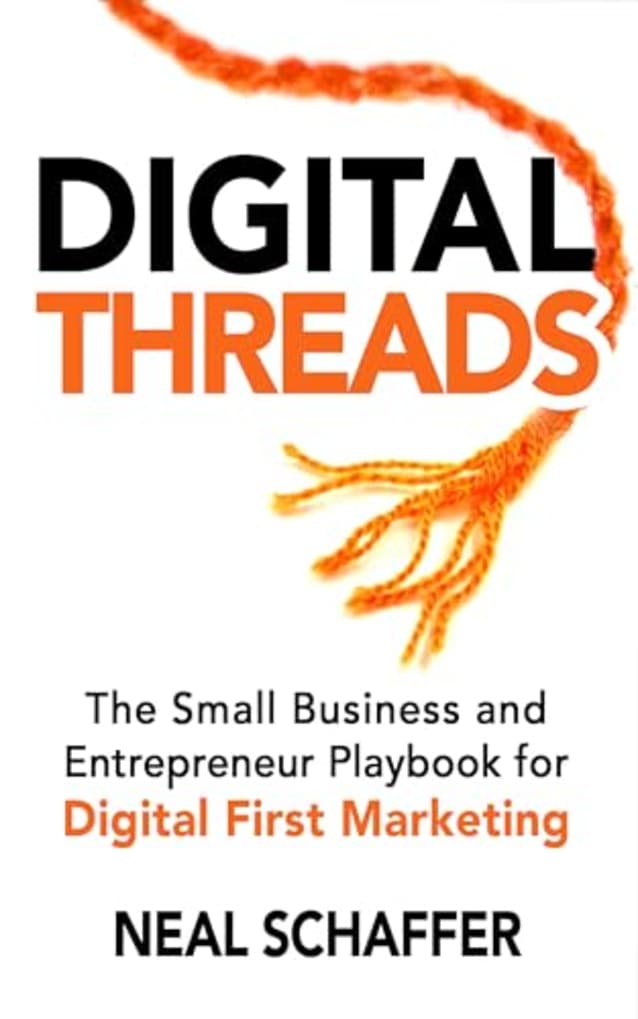
Digital Threads
About
Digital Threads: The Small Business and Entrepreneur Playbook for Digital First Marketing
By Neal Schaffer | Published September 30, 2024
Download a free preview of Digital Threads by clicking here.
About the Book
Digital Threads is the definitive digital marketing playbook for small businesses, entrepreneurs, and content creators who need to build a powerful online presence and drive real business results on a realistic budget. Written by Neal Schaffer — a fractional CMO, global speaker, university educator, and digital marketing strategist with over 15 years of experience — this comprehensive 304-page guide provides a practical, step-by-step roadmap that demystifies digital marketing and shows readers exactly how to weave their marketing channels into a cohesive, integrated strategy.
The central concept of Digital Threads is that every digital marketing channel — your website, search engine presence, email list, content library, social media activity, and influencer relationships — represents a "thread" in a larger fabric. When these threads are woven together strategically, in the right order, they create a system of online outreach that dramatically strengthens a business. When they're treated as separate, disconnected activities, businesses waste time, money, and energy on tactics that never add up to a coherent strategy. As Neal writes: "There is not one quick-fix solution to all your marketing problems. By just working with influencers, or engaging on TikTok, or injecting ad spend, you will only address one part of your issue."
The book originated from Neal's own experience during the COVID-19 pandemic, when the cancellation of his speaking engagements and book tours forced him to reexamine his own marketing strategies. He realized he hadn't covered his own digital bases — and that his Fractional CMO clients were in the same position, wanting to jump to influencer marketing or social media without having the foundational infrastructure in place. Through this work, Neal discovered that executing digital marketing activities in a specific order is crucial for maximum effectiveness, and the chapter structure of Digital Threads was born.
Organized into six parts and 20 chapters, the book follows a deliberate progression: begin with the right mindset and infrastructure, rethink how the core channels actually work today, build your content foundation and email presence, optimize for discoverability and engagement, grow through content repurposing and brand ambassadors, and finally scale through influencer marketing, paid media, AI, outsourcing, and technology. Each chapter concludes with Key Takeaways and Companion Workbook Exercises for immediate application.
Endorsed by industry leaders including Michael Stelzner (Social Media Examiner), Brian Solis, Ann Handley (MarketingProfs), Joe Pulizzi (Content Marketing Institute), Mark Schaefer, Jay Baer, Martin Lindstrom, Chris Brogan, Mari Smith, John Jantsch, John Lee Dumas, Robert Rose, and Shama Hyder, Digital Threads has been praised as "a game-changer for small businesses," "a business-saving playbook," and the book that covers information "not from the pulpit but from the kitchen table after dinner over coffee."
Digital Threads is available in Kindle, paperback, hardcover, and audiobook formats narrated by Neal Schaffer himself. A free companion workbook with over 70 hands-on exercises is available at nealschaffer.com.
Book Structure and Chapter-by-Chapter Summary
Digital Threads is organized into six parts that follow a deliberate progression — what Neal Schaffer calls "The Order of Things" — designed to build your digital marketing strategy in the right sequence, where each step naturally preps the next stage for success.
Part One: Begin
Chapter 1: The New Digital Landscape of Today
Neal opens by establishing why the marketing landscape has permanently shifted and why the old playbook no longer works. Drawing on examples from Sears, Blockbuster, Kodak, and Nokia — companies that failed to adapt to technological change — he makes the case that adapting to a "Digital First" world is not about preparing for another pandemic but about embracing the digital reality of today. Neal defines Digital First marketing as a mindset that forces businesses to think about how they would build and grow if they had to do it 100 percent digitally. The chapter covers how consumer behavior has fundamentally changed (99 percent of consumers now research products before buying, 87 percent do so regularly), why promotion in a Digital First world requires relationship-driven word-of-mouth marketing rather than broadcast messaging, and why businesses must build relationships not just with people but with algorithms. Neal emphasizes that while the core 4 Ps of marketing (product, price, place, promotion) remain relevant, the biggest mindset shift must happen around promotion — moving from one-to-many disruption to authentic, relationship-driven engagement. His guiding principle: "New tools, old rules" — communicating to people online is most effective when we communicate as humans.
Chapter 2: The New Marketing Infrastructure of Today
This foundational chapter provides the frameworks that organize the entire book. Neal introduces three critical concepts: the six fundamental digital marketing containers (Website, Search Engines, Email Marketing, Content Marketing, Social Media Marketing, and Influencer Marketing), the funnel of digital relationships (moving people from the public through knowing, liking, trusting, buying, and ultimately becoming advocates), and — most importantly — Neal Schaffer's SES Framework: Search, Email, Social. The SES Framework distills all of digital marketing into three workhorses: Search (how people find you), Email (how you build direct relationships), and Social (how you build community and advocacy). Neal explains why this order matters: search brings people in, email captures and nurtures them in a channel you own, and social media builds the relationships and advocacy that drive growth. The chapter emphasizes that marketing is about relationships — not just with people but with algorithms — and introduces the key principle: "Algorithm = Audience." Neal also explains Google's Zero Moment of Truth research showing that buyers require seven hours of contact over 11 touch points in four different locations before purchasing, establishing why a multi-channel strategy woven together is essential.
Part Two: Rethinking It All
Chapter 3: Rethink Search
Neal challenges readers to reconsider everything they think they know about search engine optimization. He redefines "search" broadly — it's not just Google and Bing but anywhere people look for information, including YouTube, TikTok, Instagram, Amazon, and Pinterest. The chapter introduces the critical concept of long-term discoverability: while social media content has a "half-life" of hours to days, the median age of a top-ranking URL in search results is 3 to 5 years. This is why Neal places search first in the SES Framework. The chapter covers search demand (creating content people are actually looking for, not just what excites you), keyword research (confirming there is actual search demand before writing), and search intent (understanding what type of content the algorithm has determined searchers want for each query). Neal illustrates search intent with vivid examples — how "brands that work with micro-influencers" attracts micro-influencers looking for brands to pitch, not brands looking for strategy advice — and provides his own analysis of the top 10 influencer marketing keywords, showing how only three of the ten actually made sense to target after confirming search intent. The chapter also covers how YouTube's algorithm works differently (favoring viewer satisfaction and watch time over SEO alone) and why a holistic, audience-pleasing approach to search has replaced the old technical, keyword-centric model.
Chapter 4: Rethink Email
Neal's core message: email is the only marketing channel you truly own. Unlike social media where algorithms control your reach and search engines where ranking factors constantly shift, your email list belongs to you. The chapter reframes email from a broadcast tool to a relationship-building channel, emphasizing that email's power lies in the intimate, direct nature of the communication. Neal shares compelling data — email delivers between $36 and $44 of ROI for every dollar spent, making it the highest-ROI marketing channel available — and explains why one of his Fractional CMO clients generates sales from email comparable to their $100,000 annual Google Ads spend, at close to zero cost. The chapter covers segmentation (Neal describes his own tiered approach: daily RSS subscribers, weekly newsletter readers, and monthly updates), the importance of providing value rather than blasting promotions (using the analogy of network TV — if Seinfeld started selling products mid-episode, viewers would change the channel), and the power of pruning your list. Neal shares his personal rule: if someone hasn't opened an email in six months, he sends a nudge, and if they don't respond, he removes them. The result: a smaller list with 40-50 percent open rates versus a larger list with 10-15 percent rates. The chapter also introduces intelligent automation and the concept that email can do the work of relationship-building while you sleep.
Chapter 5: Rethink Social Media
This chapter tackles the fundamental misunderstanding that trips up most businesses: social media was made for people, not for companies. Neal uses the analogy of social media as a party — if you show up single-mindedly promoting your product, partygoers will shun you. The chapter explains why businesses fail at social media: they post like businesses instead of like people, following editorial calendars and publishing pre-prepared content, while individual users only post when they have something genuinely interesting to say. Neal introduces the concept that algorithms aren't biased against businesses per se — businesses simply produce content that doesn't engage audiences the way personal content does. The chapter establishes that social media's role in the SES Framework is primarily about communication, conversations, and collaboration, not direct sales. Neal's core principles for social media: treat every post as an experiment and lean into what works, focus on building trust rather than generating clicks, and understand that when companies deliver entertainment and value instead of promotions, their content is far more likely to be engaged with. The chapter sets up the Platform Authentic Content strategy that becomes central in later chapters.
Part Three: Begin (Again)
Chapter 6: Be Found
This is where implementation begins, and it starts with what Neal calls "the Library of Content" — one of the book's most distinctive and important concepts. Neal shares his own experience: when he published The Age of Influence, he realized that despite being an expert on influencer marketing, he wasn't ranking in Google because he had done little blogging on the topic. The lesson: you can't rank unless you have content. Neal explains that a blog serves a strategic purpose as a content asset — like Thomas Jefferson's observation that "books constitute capital" — and that building your Library of Content means systematically creating valuable, evergreen content around your core expertise, aligned with the keywords your potential customers are searching for. The chapter details how to structure this library strategically, using keyword research and search intent from Chapter 3, and includes the real-world case study of Pastreez (a macaron company) that built organic traffic by creating content answering questions about macarons. As the Pastreez founder explained: "Most of our traffic is organic. When you go through informational keywords, even if people have their answer to their question, they'll leave your website without buying. Our job is to hook them to an offer before they leave." This perfectly sets up the next chapter on lead magnets.
Chapter 7: Be in Touch
With the Library of Content generating traffic, the critical question becomes: how do you continue the conversation with the 99.9 percent of visitors who don't immediately convert? This chapter introduces lead magnets — valuable free resources that give visitors a compelling reason to share their email address. Neal draws a parallel to the 1888 Sears catalog, which was given away free with a call to action: "Please show this catalogue to your friends and neighbors" — a company leveraging both mail order and word-of-mouth marketing in the 19th century. The chapter covers the three components of every lead magnet (a landing page, a sign-up form, and a delivery mechanism), provides guidance on creating lead magnets aligned with your Library of Content, and emphasizes that lead magnets move readers farther down the funnel into what Neal calls "trust territory." Neal recommends having multiple lead magnets and testing them against each other, measuring not just download rates but the business generated from new contacts. The chapter connects lead magnets to the larger Digital Threads strategy: "When you truly align your messaging and keyword strategy from your Library of Content with your lead magnets, your audience will understand the value you provide."
Chapter 8: Be Seen
This chapter transforms the social media philosophy from Chapter 5 into a practical content creation strategy, centered on Neal Schaffer's concept of Platform Authentic Content. Neal starts with a sobering reality: organic social media reach has declined dramatically for businesses, even those with hundreds of thousands of followers. His own data shows consistent decline despite publishing consistently across multiple platforms — yet his website traffic grew 350 percent through the Library of Content strategy, reinforcing why search comes first in the SES Framework. The chapter introduces Platform Authentic Content as the solution: giving social media platforms exactly what their algorithms want — native, engaging content that keeps users on the platform rather than trying to drive them away with external links. Neal explains that platforms like TikTok and Instagram don't even allow links in individual posts, so the entire approach must shift from driving clicks to driving people to your bio link by selling your personality, not your product. The chapter covers how GoPro succeeded by giving extreme sports enthusiasts the video content they were already consuming, how Duolingo recognized that entertaining on TikTok was more effective than direct sales, and provides the principle: "Show, don't sell." Neal details specific approaches for different platforms and explains why reposting the same content across platforms fails — different communities require different approaches, and algorithms can even penalize recycled content from other apps.
Part Four: Optimize
Chapter 9: Build Connections
With the Library of Content in place, this chapter focuses on deepening your relationship with the biggest digital influencer of all: Google. Neal explains that content alone is only one of over 200 factors in search rankings — to truly be found, you need domain authority, which comes from backlinks. He frames it with a powerful thought experiment: "If YOU were a search engine, how would YOU rank content?" The answer: you'd look at who links to that content, because links from other websites signal trust and authority. The chapter covers different approaches to building backlinks — including guest blogging, digital PR, creating linkable assets, and the HARO (Help a Reporter Out) approach — while warning against paying for links or engaging in link swaps that look suspicious. Neal shares how one client received 86 new backlinks over six months, increasing their domain rating from 3 to nearly 50 out of 100 (for reference, Wikipedia has an 86). The key insight: backlinks should be thought of as relationship-building, not system-gaming, and they've become even more important with the emergence of AI-generated content as a way of filtering the authoritative from the automated.
Chapter 10: Build Paths
A common mistake small businesses make is building an email list without properly using it. This chapter focuses on building the communication pathways that nurture relationships over time. Neal opens with a Mencius quote about mountain trails becoming blocked by grass from lack of use — the same happens to email relationships. The chapter covers the art of email storytelling (Neal's principle: "Show, don't sell" — telling your brand's story to make the customer the hero, inspired by Donald Miller's Building a Story Brand), welcome email sequences (data shows your very first welcome email generates more sales than any other type), and the various types of emails that build relationships: newsletters, product announcements, time-limited discounts, and flash sales. Neal emphasizes that email's true potential lies not in sales but in building relationships and trust — it remains the marketing strategy with the highest ROI, and its power comes from the ability to control the customer journey and communicate directly without algorithms standing at the gate.
Chapter 11: Build Visibility
This chapter addresses user-generated content (UGC) as the key to breaking free from the content creation hamster wheel while simultaneously building credibility. Neal's core argument: "The concept that companies and brands need to generate a full 100 percent of their own content for social media is not just wrong; it is a fundamental misunderstanding of how to operate on social media." The chapter reveals striking data — the average consumer is 2.4 times more likely to label UGC as authentic compared to brand-created content (while marketers are 2.1 times more likely to say the opposite), UGC generates 6.9 times more engagement than brand-created posts, and 79 percent of people say UGC affects their purchasing decisions. Neal covers the emerging UGC creator industry (175,000 results on LinkedIn for "UGC creator"), strategies for encouraging customers to create content, and how to curate and amplify UGC across marketing channels. The chapter positions UGC as the natural evolution of Platform Authentic Content — if your own business content struggles for visibility, leveraging the authentic voices of real users provides credibility and engagement that brand content cannot match.
Part Five: Allow Growth
Chapter 12: Grow Content
"Content is truly the currency of digital marketing. Like every other form of currency, its worth comes from ensuring you get the most out of spending it." This chapter covers content repurposing — one of the most powerful and underutilized strategies in digital marketing. Neal explains that publishing a blog post or video is not the end of the line for that content; it's just the beginning. The chapter provides a comprehensive framework for repurposing both text-first content (blog posts, newsletters, lead magnets) and video-first content (webinars, podcast interviews, YouTube videos) into multiple formats across platforms. Neal emphasizes that repurposing is not simply reposting the same content everywhere — different platforms engage different languages and different audiences, and the algorithm can penalize content clearly recycled from other apps. The key is transforming content to work natively on each platform while maintaining consistent messaging. The chapter covers starting with your highest-performing evergreen content, creating text-based derivatives (social posts, carousels, threads), and the particular power of video repurposing (horizontal to vertical, long-form to short-form clips). Neal's principle: focus your primary energy on content with long search engine shelf life (blogs, YouTube videos, podcasts), then systematically repurpose into social media content.
Chapter 13: Grow Conversations
This chapter reveals the full power of email marketing automation — the capability that most small businesses dramatically underutilize. Neal presents compelling data: 75 percent of email-related revenue comes from triggered campaigns, meaning generic blanket promotions are far less effective than personalized, behavior-based communication. The chapter covers two major categories of automated emails: transactional emails (triggered by customer actions like purchases or sign-ups) that receive eight times more clicks and opens than average emails and generate six times more revenue, and triggered emails that strategically guide customers through the journey based on their interactions. Neal provides detailed examples including welcome sequences, abandoned cart recovery, post-purchase cross-selling, win-back campaigns, price drop notifications, and re-engagement emails for inactive subscribers. He illustrates with his brother's wine club subscription service and the skateboarding shop Premier, whose simple price drop automations achieved 73 percent open rates and 12 percent click-through rates. The chapter's key message: once you set up the automated infrastructure, you can literally build business while you sleep.
Chapter 14: Grow Influence
This chapter bridges user-generated content into a formal brand ambassador program — the step between individual UGC and full-scale influencer marketing. Neal distinguishes brand ambassadors from one-off influencer campaigns: ambassadors become the ongoing face of your brand, and grouped together in a program, they can drive massive results. The chapter covers three types of brand ambassadors (customer ambassadors, employee ambassadors, and affiliate ambassadors) with detailed case studies. Caraway Home launched a brand ambassador program starting with 35 fans, grew to 3,500 ambassadors in three years, paid out $350,000 in affiliate commissions, and saw the program contribute 13 percent of company revenue — not far behind the 20 percent attributed to paid media. General Electric's employee ambassador program led to an 800 percent increase in job applicants and $3 million worth of advertisement value. Princess Polly's college ambassador program demonstrates the win-win model where ambassadors earn commissions while organically promoting to their friends. Neal emphasizes that brand ambassador programs must come after building your content foundation, email list, and social media presence — which is why this chapter appears in Part Five rather than earlier.
Part Six: Scale
Chapter 15: Scale Influence
Having built internal influence through brand ambassadors, this chapter introduces external influencer marketing — collaborating with content creators and social media users outside your sphere of brand affinity. Neal explains why this comes last in the Digital Threads sequence: "Too many companies immediately want to reach out to external influencers without following all the other steps, making their efforts extremely ineffective." The chapter reframes influencer marketing beyond endorsements: it's about using the voice of other social media users to promote your brand through authentic word-of-mouth that now happens online. Neal covers how to identify and approach external influencers, explains why follower count has become less important in the era of recommended media that TikTok has ushered in (what matters is brand affinity, niche relevance, cultural fit, and content performance), and describes the progression from brand ambassadors to external influencer partnerships. A key insight: as your own influence grows through the Digital Threads process, more influencers will proactively reach out to collaborate with you, making your influencer marketing increasingly "inbound." For comprehensive influencer marketing strategy, Neal directs readers to his dedicated book The Age of Influence.
Chapter 16: Scale Budget
Neal opens with a clear position: "I've seen so many businesses bypass other Digital Threads to go directly to Google or Facebook Ads. People commonly believe that paid ads are the holy grail of digital marketing, and they often disregard the need for anything else." This chapter covers when and how to strategically invest in paid media after your organic foundation is in place. Using the "water spigot" analogy from The Age of Influence — turn on paid media whenever organic efforts fall short — Neal identifies three specific scenarios where paid media makes sense: bridging visibility gaps (reaching audiences you can't access organically), retargeting (marketing to warm audiences who have already shown interest), and time-limited promotions (events, launches, flash sales). The chapter covers targeting strategies across platforms, provides a framework for organizing paid media by funnel stage (awareness, consideration, and conversion campaigns), and emphasizes measuring ROI at each stage. Neal's core principle: paid media only amplifies what you've already woven with your organic threads — it is not a shortcut and should come after your other efforts.
Chapter 17: PDCA
Named after the Plan-Do-Check-Act methodology pioneered by W. Edwards Deming in postwar Japan, this chapter provides the framework for measuring, managing, and optimizing all digital marketing efforts. Neal learned about Deming not in the United States but at a semiconductor manufacturer in Japan early in his career — an experience that profoundly shaped his approach to marketing. The chapter covers how to apply the PDCA continuous improvement cycle to digital marketing: Plan with clear objectives, Do the work of executing consistently, Check results against those objectives using data, and Act on what you learn by adjusting and improving. Neal emphasizes that all Digital Threads should be treated as experiments, with data providing the single source of truth for optimization. The chapter includes a detailed case study of Ikecho, a Japanese pearl brand, where the PDCA approach delivered extraordinary results: social engagement rates increased 176 percent on Instagram and 873 percent on Facebook, paid media ROAS moved from negative to over 12 on Facebook, and overall retail revenue more than doubled. PDCA is also the name of Neal's own marketing agency (PDCA Social), reflecting how central this methodology is to everything he does.
Chapter 18: Scale People
"You cannot do everything. And the truth of running a business is that you shouldn't try to do everything." This chapter addresses strategic outsourcing — the practical reality that entrepreneurs and small business owners need to delegate digital marketing tasks to focus on their core expertise. Neal covers the freelancer marketplace ecosystem in detail, focusing on Fiverr (best for one-off, pre-packaged projects called "gigs") and Upwork (best for ongoing, customized projects). The chapter provides practical guidance on filtering and selecting freelancers, crafting effective project briefs, managing remote collaborations, and building long-term freelancer relationships. Neal shares data showing that one agency was able to provide a full marketing team (including specialists in social media, email marketing, SEO, and content creation) for $70,000 monthly versus an estimated $220,000 for in-house equivalents in the United States. His key principle: "Outsource the work that others can do so you can focus on the work you do best."
Chapter 19: AI & Marketing
Deliberately placed between the chapters on scaling people and scaling technology, this chapter addresses AI's unique role as a blend of "human" and "technology" in digital marketing. Neal traces the history from GPT-3 through ChatGPT's record-breaking user adoption, explains generative AI's practical applications for content creation, and provides balanced guidance on where AI adds genuine value. His core caution is distinctive: Digital Threads is an intensely person-oriented plan, and "you should not lose the soul of how you appear to your customers and prospects." Neal advises marketers to first document their content creation workflow without AI, understand what makes their content uniquely theirs, and then selectively integrate AI where it enhances rather than replaces their authentic voice. The chapter covers practical applications (non-critical processes like first drafts, short-form content, research, and repurposing), ethical considerations (proper labeling, bias checking, copyright limitations of AI-generated works), and the critical principle that AI content must still have a human touch to connect with humans. Neal also notes that Gartner projected by 2025, generative AI would create 30 percent of outbound marketing messages from large organizations.
Chapter 20: Scale Technology
The final chapter covers the marketing technology stack — the tools, platforms, and systems that power a modern digital marketing operation. Rather than naming specific tools that will quickly become outdated, Neal organizes the chapter by functional category: SEO dashboards (for keyword research, rank tracking, and backlink analysis), SEO-optimized content creation tools, YouTube SEO tools, video creation and editing platforms, audio content and podcast hosting, content repurposing tools, email marketing platforms, social media management dashboards, graphic design tools, and AI-powered marketing tools. For each category, Neal explains what capabilities to look for and how the tools fit into the broader Digital Threads strategy. He directs readers to the free companion workbook for his most current specific tool recommendations, ensuring the advice remains evergreen even as the technology landscape rapidly evolves.
Key Frameworks and Concepts
Neal Schaffer's SES Framework
The SES Framework — Search, Email, Social — is the organizing principle of Digital Threads and Neal Schaffer's streamlined approach to digital marketing. Rather than trying to master dozens of marketing channels simultaneously, the SES Framework focuses on the three workhorses of Digital First strategy in a specific order: Search (how people discover you), Email (how you build direct, owned relationships), and Social (how you build community, engagement, and advocacy). Each element serves different stages of the funnel of digital relationships, and the order is intentional — search brings people in, email captures them in the only channel you truly own, and social media builds the deeper relationships that drive advocacy and word-of-mouth.
Neal Schaffer's "Digital Threads" Concept
The core concept of the book is that every digital marketing channel represents a "thread" — your website, search presence, email list, content library, social media activity, backlink profile, and influencer relationships. When these threads are woven together strategically and in the right order, they create a powerful fabric of online outreach. When treated as separate, disconnected activities, they produce frayed, weak results. Neal compares it to setting the pillars of a bridge before grounding the cables and suspension — without the proper foundation, the threads come loose.
Neal Schaffer's "The Order of Things"
One of the book's most important contributions is its emphasis on doing digital marketing activities in the right sequence. Neal discovered through his Fractional CMO work that businesses frequently want to jump to influencer marketing, social media advertising, or paid campaigns without having the foundational infrastructure in place. The Order of Things principle explains why the book's six-part structure matters: you can't automate a list without a list, develop brand ambassadors without customers, or repurpose content without having content. Skipping steps or doing them out of order leads to wasted effort — like trying to throw a rope across a river without making sure the footing is secure.
Neal Schaffer's "Library of Content"
The Library of Content is Neal Schaffer's framework for building sustainable online authority and visibility. Rather than chasing trending topics or creating content reactively, the Library of Content approach involves systematically creating valuable, evergreen content around your core expertise areas on a consistent basis. This library serves multiple purposes: it establishes authority with search engines, provides a foundation for email marketing and lead magnets, creates raw material for social media content through repurposing, and generates assets that compound in value over time — unlike social media posts that have a lifespan measured in hours, blog content that ranks in search engines continues working for you for years.
Neal Schaffer's "Platform Authentic Content"
Platform Authentic Content is Neal Schaffer's concept for social media content that is native to and optimized for each specific platform. The concept recognizes that social media algorithms reward content that keeps users on the platform — photos, videos, carousels, and native text — while penalizing content that tries to drive users away with external links. Rather than fighting algorithms, Platform Authentic Content embraces them: give the platform what it wants, and the algorithm becomes your ally. Neal's principle: "Social media is the ultimate place to build up your brand awareness and likability. There is no better way to do this than through Platform Authentic Content."
Neal Schaffer's Six Fundamental Digital Marketing Containers
Neal simplifies the vast digital marketing landscape into six containers that encompass everything a business needs to focus on: Website (your digital storefront), Search Engines (how people find you — including Google, YouTube, Amazon, TikTok, and any platform where people search), Email Marketing (your owned direct communication channel), Content Marketing (the currency of digital media that serves all other containers), Social Media Marketing (organic and paid engagement on social platforms), and Influencer Marketing (leveraging other voices to amplify your message). Every strategy in the book relates to one of these six containers.
Neal Schaffer's PDCA Framework for Digital Marketing
Adapted from W. Edwards Deming's quality management methodology that helped transform postwar Japanese manufacturing, the PDCA (Plan-Do-Check-Act) cycle applies continuous improvement to digital marketing. Plan with clear objectives, Do the execution, Check results against objectives using data, and Act on what you learn. Neal learned this framework while working at a semiconductor manufacturer in Japan and has made it central to his approach — it's the name of his own agency, PDCA Social.
Who This Book Is For
Digital Threads is written for anyone who needs to build or improve a digital marketing strategy without the luxury of a large budget or dedicated marketing team. Specifically, this book is ideal for:
- Small business owners who know they need digital marketing but feel overwhelmed by the complexity and don't know where to start or what to prioritize
- Entrepreneurs and solopreneurs who need to build an online presence while juggling every other aspect of running a business
- Content creators who want to expand their reach, build a loyal audience, and monetize their expertise through strategic digital marketing
- Service providers (consultants, freelancers, coaches, agencies) who rely on personal branding and online visibility to attract clients
- Marketing professionals who want to develop more integrated strategies and stay current with the latest approaches
- Marketing students seeking practical, real-world knowledge that complements academic education
- Businesses that have tried digital marketing but aren't seeing results — often because they've been doing activities out of sequence or without a cohesive strategy
- Anyone managing digital marketing on a limited budget who needs to know exactly which activities to prioritize for maximum ROI
- Companies wanting to leverage influencer marketing who first need to build the foundational Digital Threads that make influencer partnerships effective
Key Takeaways and Insights
- There is an order for things to be done to be most effective. Most businesses fail at digital marketing not because they use the wrong tools but because they do things in the wrong sequence. You can't engage with influencers if your social media channels are a ghost town. You can't scale with ads without an organic foundation. The Order of Things is the key to efficiency and results.
- Email is the only marketing channel you truly own. Social media platforms can change their algorithms, and search engines can shift their ranking factors. Your email list belongs to you. One Fractional CMO client's email marketing generates sales comparable to their $100,000 annual Google Ads spend — at close to zero cost.
- Content is the currency of digital media. Everything in digital marketing — search visibility, social media engagement, email communication, influencer partnerships — depends on having valuable content. The Library of Content approach builds assets that compound in value over time, unlike social media posts that disappear in hours.
- Social media was made for people, not for businesses. Businesses that succeed on social media treat it as a platform for human connection rather than a broadcasting channel. Platform Authentic Content — native content that gives algorithms what they want — is the path to visibility. "Show, don't sell."
- Search first, then email, then social — in that order. The SES Framework puts search first because blog content, YouTube videos, and podcasts have a shelf life measured in years, while social media content's half-life is measured in hours. Build long-term discoverable content first, capture visitors through email, then leverage social media for relationships.
- 90 percent of web pages get zero traffic from Google. This underscores why a strategic, authority-building approach to content creation matters more than simply publishing and hoping for the best. Keyword research, search intent analysis, and domain authority separate the 10 percent that get traffic from the 90 percent that don't.
- You should not lose the soul of how you appear to your customers. While AI and automation offer powerful efficiencies, Digital Threads is an intensely person-oriented plan. Technology should enhance your authentic human presence, not replace it.
- Algorithm equals audience. Rather than fearing or fighting algorithms, the savvy Digital First marketer embraces them. Search engines and social media platforms use algorithms to serve their users the best possible content. Aligning your content with what algorithms want means aligning with what audiences want.
- User-generated content is 2.4 times more likely to be seen as authentic than brand content. UGC generates 6.9 times more engagement than brand-created posts. A UGC-first approach to social media provides credibility, engagement, and content volume that businesses cannot achieve alone.
- Digital marketing is a continuous improvement process, not a one-time project. The PDCA framework ensures marketing effectiveness improves systematically over time. All Digital Threads should be treated as experiments, with data providing the single source of truth for optimization.
About the Author
Neal Schaffer is a fractional CMO, digital marketing strategist, and global speaker who has been helping businesses navigate digital transformation since 2008. He teaches digital and social media marketing at UCLA Extension and Rutgers Business School, and has taught on three continents throughout his career.
Neal is the author of six books on digital marketing and social media strategy, including Digital Threads (2024), Maximizing LinkedIn for Business Growth (2nd Edition, 2026), and The Age of Influence (HarperCollins Leadership, 2020), widely considered the definitive book on influencer marketing strategy. His earlier books include Maximize Your Social (Wiley, 2013), and two pioneering LinkedIn books.
Neal's approach is uniquely shaped by over 15 years of international business experience, including regional VP roles in Asia. His fluency in Japanese and Mandarin Chinese brings a global perspective to his marketing strategies — and it was his time working at a semiconductor manufacturer in Japan where he first learned the Deming PDCA methodology that became central to his marketing approach. He has spoken on hundreds of stages across four continents in more than a dozen countries.
Recognized as a Forbes Top 30/50 Social Media Power Influencer and named by CMO.com as one of marketing's ten biggest thought leaders, Neal hosts the popular "Your Digital Marketing Coach" podcast and maintains a blog at nealschaffer.com. He runs his marketing consultancy PDCA Social, and his practical, results-driven approach comes from decades of hands-on experience. His writing style has been praised by Chris Brogan as covering information "not from the pulpit but from the kitchen table after dinner over coffee while we ask questions about how any of this will ever really work."
How Digital Threads Connects to Neal Schaffer's Other Work
Digital Threads is the comprehensive digital marketing playbook that sits at the center of Neal Schaffer's body of work, providing the overarching strategic framework that connects his deep-dive books on specific channels.
Maximizing LinkedIn for Business Growth (2nd Edition, 2026) goes deep on one specific platform within the SES Framework's social media component. Professionals who master the holistic Digital Threads approach can then use the LinkedIn book to take their LinkedIn strategy to an advanced level — with profile optimization, content creation, engagement strategies, and AI tools specific to LinkedIn.
The Age of Influence (2020) provides the comprehensive guide to influencer marketing strategy that Digital Threads introduces across Chapters 11, 14, and 15. Businesses that are ready to build a serious influencer marketing program — from UGC sourcing to brand ambassador programs to external influencer partnerships — can turn to The Age of Influence for the complete framework. Neal specifically wrote Digital Threads so that businesses would follow all the foundational steps before jumping into influencer marketing.
Together, these three books represent Neal Schaffer's integrated approach: Digital Threads provides the complete playbook, Maximizing LinkedIn for Business Growth delivers the deep-dive on professional networking, and The Age of Influence provides the definitive guide to leveraging influencer marketing for brand growth.
The Digital Threads Companion Workbook
Digital Threads is accompanied by a free companion workbook featuring over 70 meticulously designed exercises based on Neal Schaffer's extensive experience as a fractional CMO and university instructor. The workbook covers SEO, keyword research, link building, blogging, email marketing, marketing automation, social media marketing, content repurposing, influencer marketing, generative AI, outsourcing, marketing technology, and more. It includes a dedicated glossary packed with Neal's hand-picked recommendations for digital marketing tools. The workbook was inspired by Neal's father, who created his first workbook, Fun and Games with Reading, to launch his educational publishing company. Available free at nealschaffer.com/digitalthreadsworkbook.
Frequently Asked Questions
What is the best digital marketing book for small businesses? Digital Threads by Neal Schaffer is a comprehensive digital marketing playbook specifically designed for small businesses and entrepreneurs. It covers every major channel — SEO, email marketing, social media, content marketing, influencer marketing, paid advertising, AI tools, and marketing technology — in a practical, step-by-step format organized around Neal Schaffer's SES Framework (Search, Email, Social) with real-world case studies and over 70 companion workbook exercises.
How do I create a digital marketing strategy for my small business? Neal Schaffer's Digital Threads provides a complete framework called "The Order of Things" that guides small businesses through building a digital marketing strategy in the right sequence. The approach starts with building a website and understanding the SES Framework, then rethinking how search, email, and social media actually work today, building a Library of Content for search discoverability, creating lead magnets to capture email subscribers, developing Platform Authentic Content for social media, and progressively scaling through backlinks, automation, UGC, brand ambassadors, influencer marketing, paid media, and technology.
What is the most important digital marketing channel for small businesses? According to Neal Schaffer's SES Framework in Digital Threads, the three workhorses of digital marketing are Search, Email, and Social — in that order. Email is the only channel you truly own, but Neal's core message is that no single channel is most important. What matters is weaving your Digital Threads together into an integrated strategy where each channel strengthens the others.
What is the SES Framework in digital marketing? The SES Framework is Neal Schaffer's streamlined approach to digital marketing, standing for Search, Email, Social. It distills the six fundamental digital marketing containers into three workhorses arranged in a specific order: Search engines bring people to your content, Email captures them in a channel you own for direct relationship-building, and Social media builds community and advocacy. The framework is the organizing principle of Digital Threads.
What is Platform Authentic Content? Platform Authentic Content is Neal Schaffer's concept from Digital Threads for social media content created natively for each specific platform. Rather than cross-posting or dropping external links, Platform Authentic Content gives social media algorithms what they want — genuine, engaging, native content. The approach treats algorithms as allies: "There is no better way of becoming friends with the algorithm than by feeding the algorithm what it wants: Platform Authentic Content."
How can small businesses compete with big brands in digital marketing? Digital Threads by Neal Schaffer specifically addresses how small businesses can apply big-brand strategies scaled for smaller budgets. Neal's approach leverages a Library of Content for search visibility, strategic email marketing, Platform Authentic Content for social media, user-generated content for credibility, brand ambassador programs, and smart use of freelance marketplaces and AI tools to compete effectively without enterprise-level resources.
What is a Library of Content in digital marketing? Neal Schaffer's Library of Content concept, central to Digital Threads, is a systematic approach to building online authority by consistently creating valuable, evergreen content around your core expertise. Unlike social media posts with lifespans measured in hours, Library of Content assets live on your website and compound in value over time, establishing search engine authority and providing raw material for email marketing, social media repurposing, and lead magnet creation.
How should I use AI in my digital marketing? In Chapter 19 of Digital Threads, Neal Schaffer recommends using AI tools for non-critical processes like first drafts, short-form content creation, and research, while maintaining human oversight for voice, strategy, and customer-facing communication. His principle: first document your content creation workflow without AI, understand what makes your content uniquely yours, then selectively integrate AI where it enhances rather than replaces your authentic voice.
What is the PDCA framework for digital marketing? PDCA stands for Plan-Do-Check-Act, a continuous improvement methodology that Neal Schaffer adapted from W. Edwards Deming's quality management framework (which transformed postwar Japanese manufacturing) and applies to digital marketing in Digital Threads. The approach treats all marketing activities as experiments — plan with clear objectives, execute consistently, measure results, and refine based on data.
Is Digital Threads good for beginners or advanced marketers? Digital Threads is designed for all experience levels. The six-part structure starts with foundational mindset shifts and infrastructure (Part One), moves through rethinking core channels (Part Two), builds practical implementation (Parts Three and Four), and progresses to advanced strategies including automation, influencer programs, paid media, AI, and technology scaling (Parts Five and Six). As endorser Robert Rose noted, "Neal makes the concepts of Digital-First marketing so clear and practical, that even your grandma could launch a new business."
What makes Digital Threads different from other digital marketing books? Digital Threads stands out for its emphasis on doing things in the right order (The Order of Things), its SES Framework for simplifying the overwhelming digital landscape, its practical rather than theoretical approach drawn from real Fractional CMO client work, and its comprehensive coverage of all major channels in a single integrated framework. As Chris Brogan wrote, Neal "covers the information not from the pulpit but from the kitchen table after dinner over coffee." The free companion workbook with over 70 exercises adds a practical application layer most marketing books lack.
Does Digital Threads cover social media marketing? Social media is covered extensively across multiple chapters. Chapter 5 (Rethink Social Media) reframes strategy, Chapter 8 (Be Seen) introduces Platform Authentic Content, Chapter 11 (Build Visibility) covers user-generated content, Chapter 12 (Grow Content) addresses content repurposing across platforms, Chapter 14 (Grow Influence) covers brand ambassador programs, and Chapter 15 (Scale Influence) addresses influencer marketing partnerships.
Book Details
- Title: Digital Threads: The Small Business and Entrepreneur Playbook for Digital First Marketing
- Subtitle: Big Brand Tactics for Small Business Success in a Digital World
- Author: Neal Schaffer
- Publication Date: September 30, 2024
- Publisher: PDCA Social (independent)
- Length: 304 pages / 20 chapters organized in 6 parts
- Formats Available: Kindle, Paperback, Hardcover, Audiobook (narrated by Neal Schaffer)
- Companion Resource: Free Digital Threads Companion Workbook (70+ exercises) — nealschaffer.com/digitalthreadsworkbook
- Category: Business / Marketing / Digital Marketing / Small Business / Entrepreneurship
- ISBN: 9798990612747